

Press release: Current attempted theft of private lands by the Red river by the BLM branch of Obama regime may coincide with the proposed NAFTA Superhighway
Posted on | April 27, 2014 | 10 Comments
Press release
Law offices of Orly Taitz
Current attempted theft of private lands by the Red river by the BLM branch of Obama regime may coincide with the proposed NAFTA Superhighway
Yesterday Judge Janine Spiro has provided an editorial excoriating Harry and Cory Reid for backroom deals and sale of public lands to Chinese for cents on the dollar and attacking ranchers because the area currently used by ranchers is needed for the allocation of the nature preserve, as the Chinese build on the rest of the land in the area.
Later she interviewed Texas ranchers who reported that BLM is trying to steal their land, which they owned for decades and for which they paid for decades. Judge Pirro and the guest wondered why now, why do the federal raiders need the land now.
Attorney Taitz looked at the maps of the proposed NAFTA Super Highway. While the globalists were quiet on the project for a while, as the nation battled other Federal takeovers of different spheres of life, this project never died. Please, see the links to the articles and map below. NAFTA corridor or NAFTA super highway passes in the area of Red river between TX and OK. Current attempted theft of private lands by the federal raiders might be connected to this construction. Further, just as the attempted theft of TX lands might be coinciding with the Great Plains corridor and NASCO corridor, affected area of Bundy Ranch coincides with the CANAMEX corridor. (see maps below)
Public is asked to weigh in.
-
Interstate 35 – Wikipedia, the free encyclopedia
en.wikipedia.org/wiki/Interstate_35Wikipedia2 History. 2.1 “NAFTA Superhighway” controversy … In Oklahoma, I-35 runs from theRed River at the Texas border to the Kansas state line near Braman.
-
The Secret Superhighway and the Homogenization of North …
www.akdart.com/med72.htmlThe secret NAFTA superhighway and the planned creation of a North … Obama quietly erasing borders. … Since 2002, the proposed right-of-way that stretched 600 miles from Laredo through North Texas and onto the Red River angered …
-
The NAFTA superhighway for Oklahoma? – The Edmond Sun
www.edmondsun.com/…/The-NAFTA–superhighway-f…The Edmond SunSep 14, 2007 – … to extend the NAFTA super highway north of the Red River, through … hundreds of miles South of our border, all the way to Canada as one of …
THE SUPERHIGHWAY FACTS
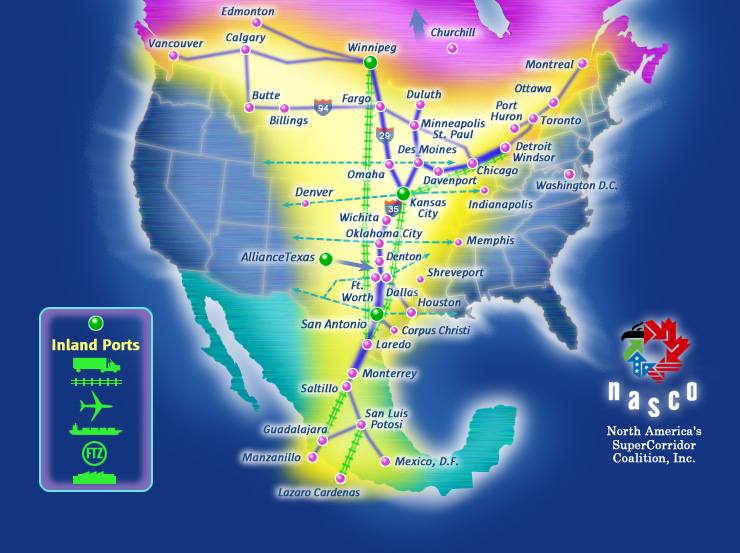
THE NEW MAP
compiled by Dee Finney
Comments
10 Responses to “Press release: Current attempted theft of private lands by the Red river by the BLM branch of Obama regime may coincide with the proposed NAFTA Superhighway”
Leave a Reply
EVIDENCE AGAINST OBAMA — YouTube Indiana Trial of Obama !
Petition the White House to institute Edward Snowden, National Whistleblower – Patriots against Government Corruption Day

 OrlyTaitzEsq.com
TAITZ REPORT


Official Facebook
IMPORTANT NOTICES – PLEASE READ!
Historic DVD Now Available! DVD of the historic trial in GA and DVD of a historic testimony in NH, where evidence was provided showing Obama using a forged birth certificate and a stolen social security number. The DVDs are in a beautiful commemorative case with personal autographs from attorney Dr. Orly Taitz $22.50 each +$2.50 for shipping and handling.
---------
To order these DVDs, donate $25.00 by credit card on the website RunOrlyRun.com and email orly.taitz@gmail.com with you name and address. Or send a $25.00 check with your name and address to: Orly Taitz for US Senate 2012, 29839 Santa Margarita ste 100, RSM, CA 92688.
DVD of the historic trial in GA and DVD of a historic testimony in NH, where evidence was provided showing Obama using a forged birth certificate and a stolen social security number. The DVDs are in a beautiful commemorative case with personal autographs from attorney Dr. Orly Taitz $22.50 each +$2.50 for shipping and handling.
---------
To order these DVDs, donate $25.00 by credit card on the website RunOrlyRun.com and email orly.taitz@gmail.com with you name and address. Or send a $25.00 check with your name and address to: Orly Taitz for US Senate 2012, 29839 Santa Margarita ste 100, RSM, CA 92688.
Advertisement / Sponsors
 29839 Sta Margarita Pkwy,
Ste 100
Rancho Sta Margarita, CA 92688
orly.taitz @gmail. com
(949) 766-7687

--------------------------------------
 Videography by Barbara Rosenfeld
--------------------------------------

Bumper Sticker
$9.99 thru PayPal--------------------------------------

--------------------------------------Orly Taitz Photo Collections





April 27th, 2014 @ 4:41 pm
NAFTA -clinton-bush= traitors. Should be “nullified.” with supporters held accountable.
April 27th, 2014 @ 6:35 pm
Janine Spiro? You mean Jeanine Pirro?
April 27th, 2014 @ 7:41 pm
We were just practicing for our assault on the Taitz Compound. Got ammo?
April 27th, 2014 @ 8:40 pm
Is this why there will be no pipe line? A Super Highway for the “North American Union”. And no more Constitution, or United States or boarders? The Trilateral Commission & CFR & bankers dirty tricks, the whores of DC have sold the american people and all the servicemen that have fought for our rights and freedom…..down the river!
Found this chart on Dirty Harry’s land deals:
http://www.monacointelligenceservice.com/2014/04/land-grab-harryland.html
April 28th, 2014 @ 5:13 am
The Highway is ALREADY Complete here in South Dakota. They “Call” it The Heartland Express.
The Nebraska portion has been On & Off for Years. I remember several years ago, They Unearthed A Old Native American Grave Site, THAT Set Them Back A Couple Years.
They seem to Get what They Want, At ANY & ALL Costs.
April 28th, 2014 @ 5:22 am
Don’t forget banking.
MEMORANDUM OF UNDERSTANDING CONCERNING THE
RESOLUTION OF INSURED DEPOSITORY INSTITUTIONS AND CERTAIN OTHER FINANCIAL COMPANIES WITH CROSS-BORDER OPERATIONS IN THE UNITED STATES AND CANADA
https://www.fdic.gov/news/news/press/2013/pr13051.pdf
April 28th, 2014 @ 7:26 am
Wow. ..FOLKS.
This is now open and shut. What’s that you ask?
This is WHY the Keystone Pipeline is being held up and some (like OBAMA and his obamaknights) want it canceled!
Look at the fricken map. WOW. Same spot!!!!
The “THEY” out there want all the oil from Canada to go by TRUCKS not pipelines.
Who owns the trucking company who contracts oil hauling?
HHHHhhhhhhMMMMMMMmmmmmmm Indeed.
peace
josh
April 28th, 2014 @ 8:35 am
Pick Your Poison For Crude — Pipeline, Rail, Truck Or Boat
14 comments, 12 called-out Comment Now
Follow Comments
Crude oil is moving around the world, around our country, around pristine wilderness, around our cities and towns. It’s going to keep moving, will undoubtedly increase during our new energy boom, so what is the safest way to move it?
The short answer is: truck worse than train worse than pipeline worse than boat (Oilprice.com). But that’s only for human death and property destruction. For the normalized amount of oil spilled, it’s truck worse than pipeline worse than rail worse than boat (Congressional Research Service). Different yet again is for environmental impact (dominated by impact to aquatic habitat), where it’s boat worse than pipeline worse than truck worse than rail.
So it depends upon what your definition is for worse. Is it death and destruction? Is it amount of oil released? Is it land area or water volume contaminated? Is it habitat destroyed? Is it CO2 emitted?
In both the United States and Canada, more crude oil, petroleum products, and natural gas are transported in pipelines than by all other modes combined, using the unit of ton-mile which is the number of tons shipped over number of miles (The Fraser Institute).
In the U.S., 70% of crude oil and petroleum products are shipped by pipeline. 23% of oil shipments are on tankers and barges over water. Trucking only accounts for 4% of shipments, and rail for a mere 3%. In Canada, it’s even more lopsided. Almost all (97%) of natural gas and petroleum products are transported by pipelines (Canadian Energy Pipeline Association).
Amid a North American energy boom and a lack of pipeline capacity, crude oil shipping on rail is suddenly increasing. The trains are getting bigger and towing more and more tanker cars. From 1975 to 2012, trains were shorter and spills were rare and small, with about half of those years having no spills above a few gallons (EarthJustice.org). Then came 2013, in which more crude oil was spilled in U.S. rail incidents than was spilled in the previous thirty-seven years.
Crude is a nasty material, very destructive when it spills into the environment, and very toxic when it contacts humans or animals. It’s not even useful for energy, or anything else, until it’s chemically processed, or refined, into suitable products like naphtha, gasoline, heating oil, kerosene, asphaltics, mineral spirits, natural gas liquids, and a host of others.
U.S. Refinery Capacity by PADD (Petroleum Administration for Defense Districts) in 2012. Source: Congressional Research Service; Energy Information Administration U.S. Refinery Capacity by PADD (Petroleum Administration for Defense Districts) in 2012. Source: Congressional Research Service; Energy Information Administration
Every crude oil has different properties, such as sulfur content (sweet to sour) or density (light to heavy), and requires a specific chemical processing facility to handle it (Permian Basin Oil&Gas). Different crudes produce different amounts and types of products, sometimes leading to a glut in one or more of them, like too much natural gas liquids that drops their price dramatically, or not enough heating oil that raises their price.
As an example, the second largest refinery in the United States, Marathon Oil’s GaryVille Louisiana facility, can handle over 520,000 barrels a day (bpd) of heavy sour crude from places like Mexico and Canada but can’t handle sweet domestic crude from New Mexico.
Thus the reason for the Keystone Pipeline or increased rail transport – to get heavy tar sand crude to refineries along the Gulf Coast than can handle it.
The last entirely new petroleum refinery in the United States opened in 1976 (Congressional Research Service). Since then, the number of refineries has steadily declined while refining capacity has concentrated in ever-larger facilities. 25% of U.S. capacity is found in only eleven refineries. Recently, Shell’s Baytown refinery in Texas, the largest in the nation, was expanded to 600,000 bpd. Most of the big refineries can handle heavy crude, but many smaller refineries can process only light to intermediate crude oil, most of which originates within the U.S.
Thirty-three states have refineries, and most refineries can handle tens-of-thousands to hundreds-of-thousands of barrels per day, but the largest capacity sits around the Gulf Coast and in California where the oil boom in America began. However, in the 1990s after production of sweet domestic crude had significantly declined from mid-century highs, the big companies like Exxon, Shell, CITCO and Valero spent billions upon billion of dollars to retool their refineries to handle foreign heavy crudes.
Oil spill volume per billion-ton-miles compared among transportation modes. Source: the Congressional Research Service Oil spill volume per billion-ton-miles compared among transportation modes. Source: the Congressional Research Service
With the number of refineries decreasing, and capacity concentrating in fewer places, crude usually has to be moved some distance. There are four ways to move it over long distances: by pipeline, by boat, by truck, or by rail. Each has its unique problems and none is without harm.
The question is: which is safest and which should we invest in most? Take two spills for comparison.
The Quebec train wreck last year killed 47 people and spilled 1.5 million gallons of crude onto land (Bloomberg.com). The Enbridge pipeline rupture in 2010 spilled over a million gallons of similar crude into the Kalamazoo River but did not kill anyone (Wikipedia).
Contamination of water is generally much worse for the environment than contamination of land as it spreads quickly over more area and impacts more species and habitat. But killing people makes a big difference. I don’t want to put a price tag on human life, but the Government has, and it’s about $8 million a person (NYTimes).
So the Quebec train derailment cost over $400 million in human life, and will cost another $150 million or so for clean-up and rebuilding the town. The Enbridge pipeline cost no human lives but will cost about a billion dollars to clean-up and, like the Exxon Valdez, will never really succeed.
Note: using this value of $8 million a person, we 300 million Americans are worth $2.4 quadrillion, hmm…maybe not a good number. If we use our net value for America as a whole, about $75 trillion, divide by 300 million people, then the average value of a human life in America would be $250,000. So the Quebec train derailment cost less than $12 million in human life. Thus the danger of trying to gauge the value of a human life.
These are not easy questions and one’s vested interest has a great deal of sway in the answer. You really do need to pick your poison.
Like always, it will probably come down to money. And it won’t be about jobs (Pipeline Jobs), regardless of which end of the spectrum you believe, because there just isn’t enough jobs to matter compared to the value of the oil itself and the refinery capacity. It’s simply cheaper and quicker to transport by pipeline than by rail or by truck. The difference in cost is about $50 billion a year for shipping via the Keystone versus rail, totally eclipsing any economic effect of jobs in either direction.
A rail tank car carries about 30,000 gallons (÷ 42 gallons/barrel = about 700 barrels). A train of 100 cars carries about 3 million gallons (70,000 barrels) and takes over 3 days to travel from Alberta to the Gulf Coast, about a million gallons per day. The Keystone will carry about 35 million gallons per day (830,000 barrels). This puts pressure on rail transport to get bigger and bigger, and include more cars per train, the very reason that crude oil train wrecks have dramatically increased lately.
The Congressional Research Service estimates that transporting crude oil by pipeline is cheaper than rail, about $5/barrel versus $10 to $15/barrel (NYTimes.com). But rail is more flexible and has 140,000 miles of track in the United States compared to 57,000 miles of crude oil pipelines. Building rail terminals to handle loading and unloading is a lot cheaper, and less of a hassle, than building and permitting pipelines.
It isn’t acceptable to just say we shouldn’t be moving oil, because we will for the next decade or more, no matter what. So, keeping in mind the difference between death/damage to humans and damage to the environment, which would you choose?
Like a few weeks ago, I would appreciate just one comment from each person for the first 24 hours after posting so we can get a tally before we get into the normal animated back and forth debates. Below is some more information on each transportation mode.
Rail
Two seemingly opposite facts –
1) from 1980 to 2012, the train accident rate in the United States fell 80 percent, the rail employee injury rate fell 85 percent and the RR crossing collision rate fell 82 percent, but
2) more crude oil was spilled in U.S. rail incidents in 2013 than was spilled in the previous thirty-seven years.
Huh?
Using data from the Pipeline and Hazardous Materials Safety Administration, 1.5 million gallons of crude oil were spilled from rail cars in 2013. On the other hand, from 1975 to 2012, railroads spilled a total of 800,000 gallons of crude oil (McClatchy; check out their great interactive map of spills over space and time).
Even worse, these data do not include rail accidents in Canada. 1.5 million gallons of crude oil spilled in a single day last year in Lac-Megantic, Quebec, and 47 people were killed. The shipment did originate in North Dakota so take your pick of provenance.
If crude oil shipping on rail is becoming a preferred mode for oil producers in our North American energy boom, this trend is very disturbing. In 2011, crude rail capacity between southern Alberta and the northern U.S. Great Plains tripled to about 300,000 barrels per day, about a third of the Keystone XL capacity. U.S. railroads delivered 7 million barrels of crude in 2008, 46 million in 2011, 163 million in 2012, and 262 million in 2013 (almost as much as that anticipated by the Keystone XL alone). To replace the Keystone XL with rail shipments would mean another doubling of rail capacity, but that would be just another couple of years given this trend.
The Association of American Railroads points out that over 11 billion gallons of crude were shipped in 2013, so these spills account for only one-hundredth of one percent. On the other hand, the environment and people’s health don’t care about what made it though OK, just what was spilled.
Our railroad infrastructure was not built to handle this mass of crude on its system and doesn’t use enough specialty cars. If this trend continues, major infrastructure investments need to occur on both sides of the border, as well as significant changes in protocol and regulation.
Like: big oil trains have to go slower, or oil tank cars have to be hazardous material cars.
It turns out that the rail industry recently modified its guidelines in response to the Quebec derailment (Congressional Research Service) as follows:
restrict train speeds to less than 50 mph
increase the frequency of track maintenance
install wayside defective equipment detectors, such as “hot box” detectors, that detect wheels with faulty bearings, every 40 miles, with specific protocols for conductors when defects are indicated
use only track in good condition to support speeds of 25 mph or higher.
Reducing train speed can reduce the number of cars that derail as well as the likelihood that oil will be released from those cars, or that explosions will result.
Truck
Although the news is filled with comparisons between pipelines and trains, the third vector is trucks. While we can compare relative risks, the issue with trucking is that it takes lots and lots of trucks to move billions of gallons of crude since a single tank trailer only holds about 9,000 gallons or 200 barrels, a little under a third of a rail car. Our present fleet only handles 4% of our needs, so shipping by truck instead of the Keystone XL would take another million-and-a-half tanker trucks. Trucking is the most risky form of transport from an accident standpoint (yes, driving is one of those things, like smoking, that will always be in the top four most risky things to do – What’s Really Gonna Kill You?) and also from a spill standpoint. However, it is the least impactive from an environmental standpoint since each truck is small and is mainly on land, so large spills to waterways are less likely than any other mode of transport.
What is important to note, however, is that regardless of the long-hauling mode, most petroleum eventually gets onto a truck for the short moves. This limits the tons-mile risk but increases the incident number risk.
In a white paper about the dangers of transporting dangerous goods by truck, the Canadian Trucking Alliance repeats its long-standing position that “the federal government should introduce a universal mandate requiring all trucks, where the driver is currently required to carry a logbook under the federal hours of service regulations, to be equipped with an electronic recording device; and introduce a manufacturing standard (in lock-step with the United States) requiring all new heavy trucks to be equipped with a roll stability system” (Canadian Trucking Alliance). In addition, the Alliance wants all Canadian provinces and U.S. states to follow Ontario’s and Quebec’s lead by requiring truck speed limiters.
Boat
Ship transport is possible along coastal waters and along large rivers and is the method that is used for almost all foreign imports except from Canada. The thing about ships is that they carry a lot of oil per boat and many of the largest spills in history are from boats, such as the Exxon Valdez and the latest one from a collision in the Houston Ship Channel just last month (NOLA).
Five out of the ten largest oil spills in U.S. history were from boats (List of oil spills). Most important is that they have immediate impact on aquatic ecosystems both in the ocean, in rivers, or along shorelines that are usually sensitive habitats. I still don’t understand why these keep happening with modern technologies to detect water depth and nearby boats. Human error needs to be better removed from this equation.
Pipeline
The most controversial transport mode today is pipeline, mainly because of the Keystone XL debate and the recent Pegasus and Enbridge pipeline ruptures. The industry points to the generally good safety record in terms of percentages. Among oil pipeline workers, the rate hospitalization was 30 times lower compared to rail workers involved in transporting oil, and 37 times lower than for road transport, between 2005 and 2009, the latest period for which complete data exists (Intermodal Safety in the Transport of Oil).
But pipeline spills are inevitable. About 280 pipeline spills occur each year in the U.S. that are deemed significant (USDOT), that is, either there is a fatality or injury requiring in-patient hospitalization, it causes $50,000 or more in total costs (measured in 1984 dollars), there are highly volatile liquid releases of more than 5 barrels or other liquid releases of more than 50 barrels, or there are liquid releases that result in an unintentional fire or explosion.
Again, you’ll notice that these measures are in human health and property damage, not environmental effects. Environmental impacts are very difficult to estimate and, in almost all cases, are not even attempted.
In the end, all of these transportation modes can be made safer if stricter regulatory controls and modern technologies are emplaced, but the questions remain – can we make the industry comply and which ones do we want to invest in?
Finally, what brave reader wants to calculate the value of an acre of land destroyed by an oil spill? The EU recently allotted $100 per acre for removing pristine land for energy use, but this seems way too low. My muse suggests you start with Sierra Club, NRDC and EDF.
https://www.forbes.com/sites/jamesconca/2014/04/26/pick-your-poison-for-crude-pipeline-rail-truck-or-boat/
******************************
…”As Glenn pointed out, the oil that would have come in the pipeline would still be coming to the United States regardless, only now it would be through trains. And who owns the trains? Warren Buffett.
“The question is not about the environment or government studies,” Glenn said.
According to research done by GBTV and The Blaze, “Warren Buffett’s Burlington Northern Santa Fe LLC railroad — a unit of Buffett’s Omaha, Nebraska based Berkshire Hathaway — would be among those poised to reap sizable gains by the administration’s decision to reject TransCanada’s oil pipeline permit. Berkshire Hathaway purchased a 22% (or, $34 billion share) of the 32,000 mile line in 2009, shortly after Obama was elected.”
“Whatever people bring to us, we’re ready to haul,” said Burlington Northern spokesperson Krista York-Wooley.
Glenn said that Warren Buffet has vehemently denied ever speaking to The President about the Keystone Pipeline project despite the fact that he owned a company that would benefit from it’s cancellation.”…
https://www.glennbeck.com/2012/04/17/how-do-warren-buffett-and-sen-ben-nelson-benefit-from-the-white-house-killing-the-keystone-pipeline/
April 28th, 2014 @ 8:48 am
“Canadian oil companies have made it clear that they plan to develop the oil sands, with or without Keystone XL. If the oil sands are moved via rail and tanker instead of the pipeline, the result will be a 28 percent increase in greenhouse gas emissions. Similarly, transporting to existing pipelines via rail instead of Keystone will create almost 40 percent more emissions. And using only rail to transport the oil sands to the Gulf of Mexico will increase emissions 42 percent more than the proposed pipeline would.”
Read the article:
https://www.forbes.com/sites/robertbradley/2014/02/12/keystone-xl-opposition-all-cause-no-benefit/
April 28th, 2014 @ 9:05 am
(sidebar: “Pick Your Poison For Crude — Pipeline, Rail, Truck Or Boat” article is dated 4/26/2014)
Robert Bradley Jr.
OP/ED 2/12/2014 @ 1:43PM 3,034 views
Keystone XL Opposition: All Cause, No Benefit
Comment Now Follow Comments
Despite environmentalists’ best efforts to stall the approval process of the Keystone XL pipeline, it looks like some real progress may actually be made in the near future. The State Department just released its long-awaited analysis of the project’s environmental impact. The study’s key finding: building and maintaining Keystone would have virtually no effect on global carbon emissions. In fact, without the pipeline, emissions will presumably rise because the oil sands will be transported by more carbon-intensive means.
And like that, the Obama administration’s public justification for stalling approval of the project collapses. The President has always said he wanted to wait until he had final word on its environmental effects. With this new analysis, he’s got it. Time to act in what the president calls a “year of action,” right?
Environmental activists now find themselves in an ironic place. It’s no secret they are staunchly opposed to the Keystone XL pipeline, and have made anti-pipelining a defining crusade. But after going all out to politically block construction, activists are waking up to the realization that the profit motive is devising ways to ship crude oil from Montana, North Dakota, and Canada to Gulf Coast refineries.
If the environmentalists’ primary goal, as we were led to believe, was to discourage the production of Canada’s oil sands and prevent the importation of oil sands-derived oil in the United States, they have failed miserably. Their staunch opposition has actually encouraged entrepreneurs to use surface modes of transportation to deliver huge quantities of Canadian and Upper Midwest crude to southern refineries. No environmentalist that I know of has made a case for rail over pipe, so there must be non-ecological drivers at work. And now, this new State Department report may finally force the federal government to act on Keystone XL.
Canadian oil companies have made it clear that they plan to develop the oil sands, with or without Keystone XL. If the oil sands are moved via rail and tanker instead of the pipeline, the result will be a 28 percent increase in greenhouse gas emissions. Similarly, transporting to existing pipelines via rail instead of Keystone will create almost 40 percent more emissions. And using only rail to transport the oil sands to the Gulf of Mexico will increase emissions 42 percent more than the proposed pipeline would.
In the last six months, several Canadian oil companies have announced rail projects designed to get around Keystone opposition. They are building three large terminals in western Canada which will be able to load an estimated 350,000 barrels of oil a day—about 40 percent of Keystone’s planned capacity—on trains bound for the United States. Overall, Canada is expected to quadruple its oil loading capacity to 900,000 barrels a day.
The blockage of Keystone XL has also encouraged barging Canadian oil to the United States. According to The Motley Fool, Calumet Specialty Products Partners, L.P., plans to upgrade a dock on Lake Superior where Canadian crude will be loaded onto barges for shipment through the Great Lakes. In the Northwest, refining giant Tesoro and oil service company Savage are seeking permits to construct a 42-acre facility at the Port of Vancouver on the Columbia River that could handle 380,000 barrels of oil a day.
Furthermore, it appears that a pipeline to carry Canadian crude oil to the Lower-48 will be built anyway, despite the environmentalists’ best efforts. Enbridge Inc. has received permission to begin construction of its Flanagan South Pipeline stretching from Flanagan, Illinois, which is just southwest of Chicago, to Cushing, Oklahoma.
Unlike Keystone XL, Flanagan South will not cross the U.S.-Canadian border and does not need presidential approval. The Sierra Club and National Wildlife Federation recently sought an injunction to stop construction, but U.S. District Court Judge Kentanji Brown Jackson ruled against them, noting that the environmental groups failed to prove “irreparable harm” would result if construction proceeded while litigation to stop the pipeline continued.
“The Court is not convinced that the balance of harms and public interest factors weigh in [the environment groups’] favor,” Judge Jackson found. She is correct. The public needs oil, the economy runs on oil, and the project is anchored by willing buyers and sellers. Taxpayer subsidies and government mandates are not required. And pipeline safety compared to other forms of oil movement speaks for itself.
These facts are not lost on Suncor Energy, which is one of Canada’s largest oil companies. It recently announced a capital spending program of more than $7 billion for 2014 and plans to increase its oil sands production by 10 percent. The company’s production reached 396,000 barrels a day near the end of 2013, accounting for about 20 percent of Canada’s total oil sands production.
For his part, President Obama has delayed a decision on Keystone XL pipeline for five years, choosing instead to conduct study after study. Now, with the State Department putting environmentalist hysteria to bed once and for all, he has 90 days to determine if the project is in the nation’s interest.
While his delaying tactics may have helped to shore up his base, and even reward donors, the president can no longer refuse to choose the best energy option for America’s future. The U.S. Energy Information Administration projects that oil and natural gas will continue to account for 60 percent of the county’s energy needs and more than 90 percent of its transportation fuels for many years to come.
So long as the president continues to delay Keystone XL, and environmentalists focus on short-sighted political gains, America is missing out on an economic-environmental win-win. Especially in light of the recent study, the president should allow the fourth leg to complete the overall Keystone project. Recalcitrant environmental groups should end their “bizarre” (as characterized by the Washington Post) opposition.
https://www.forbes.com/sites/robertbradley/2014/02/12/keystone-xl-opposition-all-cause-no-benefit/